

🇵🇹 There’s a Portuguese language version.
https://doi.org/10.5281/zenodo.23219742
In a previous post, I outlined how I integrate activities into my courses that explicitly allow students to use artificial intelligence tools. Today, I am beginning to share brief notes on some of the practical details that emerge when we try to put those ideas into practice.
The situations, topics and dialogues with human beings in the examples are fictional, formulated as archetypes built from situations I have personally encountered as a lecturer. In other words, both the general circumstances and the details are different; only the overall pattern remains. They neither reproduce nor paraphrase students’ contributions. Non-human elements, such as excerpts from assignment briefs, are real.
Today’s detail concerns the dynamics that can be encouraged in online forums in such environments. In the Object-Oriented Programming course I used as an example in that previous post, project-based learning is employed. Those are individual projects, so each student needs to define their own. This already creates an opportunity to explore the course topics through multiple interpretations of what would otherwise remain a generic and superficial idea.
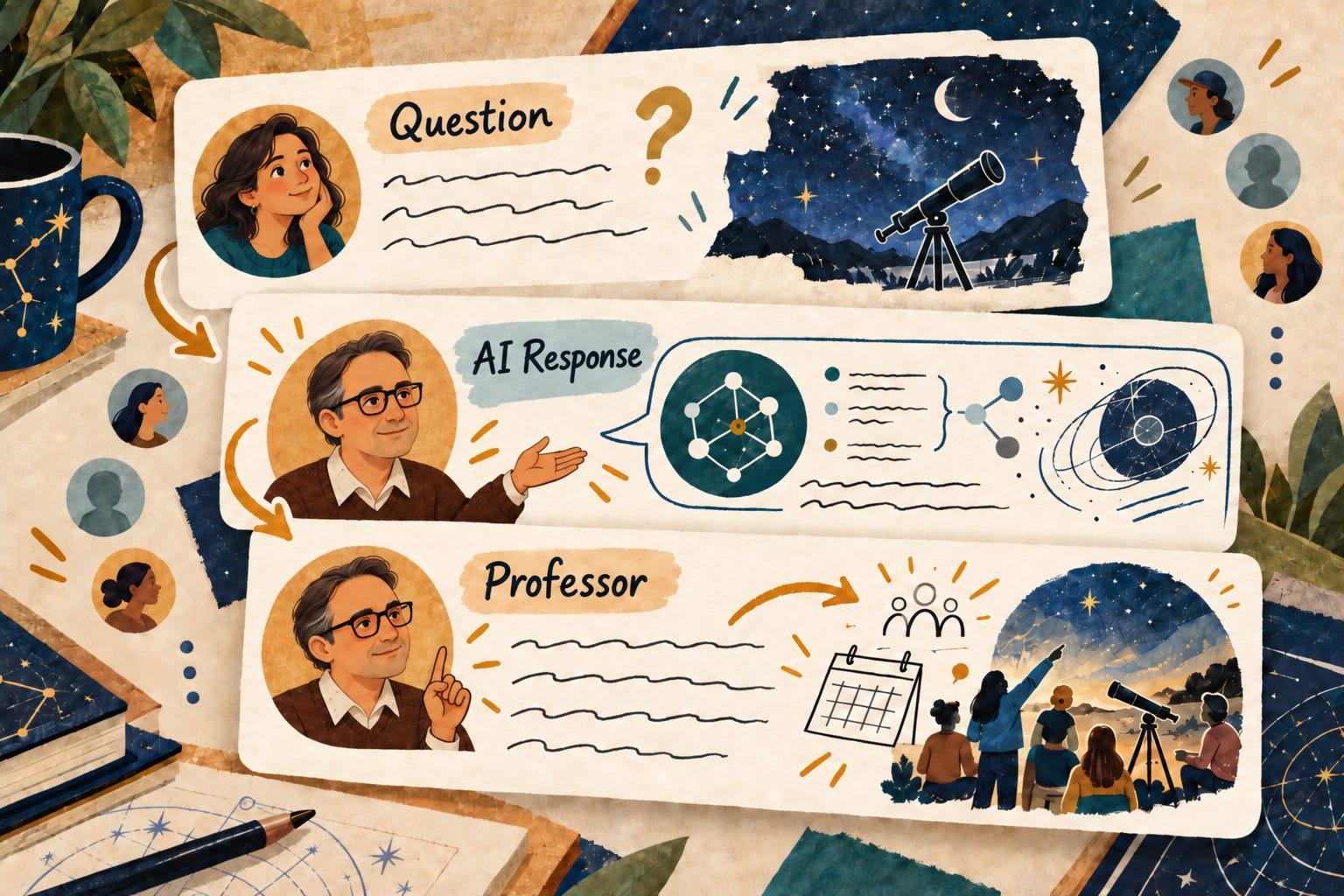
Well then, as students do the activities, (asynchronous) interaction takes place in the course forums. So, imagine a question like this being posted:
Professor, I’m thinking of developing a program to help my astronomy association prepare observation nights. Whoever organises one chooses what they want to observe, and the program would help allocate the available telescopes among the coordinators taking part, depending on the number of people registered. I imagine it using weather forecasts and calculating which objects will be visible that night. I’m just not sure whether I’m trying to do too much for one semester.
If I leave the astronomical coordinate calculations until later and work only with coordinate data entered by the organiser, would the idea still be sufficiently rich for this activity?
Fictional question and project, as archetypes based on teaching experience.
This is a legitimate concern. The student is already starting from something highly desirable: a project in which they have a genuine personal interest, where they are in a position to make decisions that matter to them and to evaluate contexts and qualities. This matches the assignment brief, which asked for a project that was interesting to the student, rich in structural decisions, and feasible within the semester.
But the student is worried that they may not be able to complete a feature which, at this early stage, seems advanced. This relates to the assessment rubric, where I had explicitly stated the following criterion, among others:
The idea is feasible within the semester (as a functional proof of concept, not as a finished product).
Excerpt from the Object-Oriented Programming Activity 3.1 brief, 2025–2026.
Notice that this is a potentially paralysing question. Because this is asynchronous e-learning, the student may have several other structural decisions that depend on resolving it. By taking the question to the professor first, they have to postpone those decisions. Yet the course already recommends using AI in general and even provides several AI chatbots configured specifically for the course. Had the student consulted them, one might, of course, have remained in exactly the same position; but one might also have become unstuck, or at least become aware of other aspects of the question.
This creates an opportunity to make everyone in the forum (not just one student) aware of this. I would reply with something along these lines below. It is inspired by a real situation, but deliberately different so that it cannot be identified:
Thank you for the question. I will answer it, but have you noticed that you could have consulted one of the AIs that has the course context in order to reflect on this first? That might have helped you identify aspects you were already able to resolve yourself, and distinguish them from those where discussing things with your colleagues or with me would genuinely be useful.
I took the initiative of putting your question to Digital Socrates, after first providing it with the assignment brief. Here is its response:
Fictional response, as an archetype based on teaching experience.
Yes — it can still be sufficiently rich for Activity 3.1, because the provided criterion does not require weather forecasting or astronomical calculations. It requires the project to be rich in decisions concerning state, behaviour, responsibilities, classes/instances and abstraction, while also remaining feasible within the semester.
There is, however, an interesting tension in the simplification you are proposing: you say that you would leave the astronomical calculations until later, while retaining “coordinate data entered by the organiser”. If the program is not yet calculating object visibility, what purpose do those coordinates serve in this version? Are they information that actually participates in a system decision, or merely data being stored in anticipation of future functionality?
The main question I would ask you is this:
If you completely remove weather forecasting and visibility calculations, what non-trivial decisions does the program still have to make when allocating telescopes among coordinators and participants?
For example, without defining the solution at this stage: are all telescopes equivalent for the purposes of that allocation? Are all coordinators equivalent too? If they are, the allocation risks becoming little more than a simple numerical division; if they are not, where do those differences lie, and what consequences do they have for organising the observation night?
That is where I would look — more than in the celestial-coordinate calculations — to determine whether the reduced version still preserves the richness in object-oriented programming that the activity is intended to elicit.
Response from Digital Socrates to the prompt above, high reasoning, translated from the Portuguese-language version,
October 7, 2026.
And then I would give a second response, so that the change is noticeable:
This response from Digital Socrates is helpful and relevant. What I would add is this: of everything the program could do, what interests you most? By postponing those coordinate calculations, might you inadvertently be shifting the focus towards tasks that are less interesting to you, such as maintaining records of coordinators, assistants and participants, managing the telescope inventory, and so on?
It is worth reflecting on what motivates you: what would make you actually want to use this program in your association? Imagine it as a story, for example. What would happen when using your program on a night when several telescopes are available but only a few coordinators? What kind of help from the program would you miss most?
That will help you decide what you genuinely want to achieve during the semester.
Fictional response, as an archetype based on teaching experience.
As I described in the previous post, the assignment already requires a storyboard and interface mock-ups. What I am suggesting in this response does not add extra work; rather, it leverages work that is already required in order to address what the student actually needs.
But the important point is that I brought the AI’s response into the public conversation, rather than simply replying myself. I have two reasons for doing this.
The first concerns legitimising its use. It is true that the course rules explicitly allow the use of AI, and references to that are prominent throughout the instructions; suggested AI interactions are even provided. Yet a student may still hesitate to acknowledge using it publicly. They may worry that the professor is merely trying to appear trendy, while deep down considering AI use a way of avoiding the work. Or perhaps they do not think that of the professor, but fear that their classmates will devalue their work because of it. Written permission, here as in many other situations in our lives, coexists with conflicting experiences and expectations. How often have we had unpleasant surprises after trusting what was written?
The moment I personally consult an AI and bring its response into the forum, that written permission acquires a different meaning within the pedagogical interaction. It begins to create moral and emotional license for students to do the same. It shows that a contribution obtained through AI can enter the conversation (and demonstrates how) not as empty filler, but as an effective contribution that enriches the discussion. In other words, I am trying to make the stated rules become the lived reality.
The second reason concerns intellectual engagement. I want students and their peers to be able to develop their intentions and efforts with cognitive support, and I want my own guidance to help deepen their work. A useful AI response such as this supports that process while creating room for questions that deserve a longer human conversation. Notice how the two responses (the AI’s and mine) complement one another, with the combination being stronger than either response in isolation. Using AI in this way still requires us to keep thinking about what we want to do and about the meaning of the choices we make along the way.
This is how I understand pedagogical activity through co-intelligence, within a cognitive ecosystem. In the perspective I developed with Eliane Schlemmer and José António Moreira, teaching and learning take place through relationships and interactions that cut across people and technologies.
In this small example, connecting the student’s project topic (a fictional example) to their astronomy association gives the project personal meaning; the assignment brief frames the academic ambition and sets boundaries for conversations with AI; and people and AI interact, shaping knowledge.
Teaching experience allows us, in small situations such as this one, to perceive the delicate balances that either make our guiding ideas viable or undermine them. That is why I am sharing this example, as I intend to share others. Integrating AI into a course means rethinking these small moments and teaching actions. It is the everyday work of making sense of what we do in response to what happens, and of turning ideas into practice.