

🇵🇹 There’s a Portuguese language version.
Edit: thank you, Aidan Kehoe, for suggesting a native-speaker editorial change to the title.
Perhaps artificial intelligence will finally force us to take seriously an old educational ambition.
Not the tiny ambition of using one more tool, nor the dazzled eagerness to stamp “Now with lemon scent and AI” on everything we already do. I mean an older ambition: deep understanding, reflection, the creation of personal meaning, developing the ability for transfer across contexts, for active participation in a community, for critical thinking decision-making. In short: the ambition of teaching for the development of each person and their purpose. Teaching for freedom: the freedom to decide that comes from awareness and knowledge.
That ambition was not born now with AI. It was not even born in this century or the last. We can see it clearly in John Dewey’s My Pedagogic Creed1, from 1897.
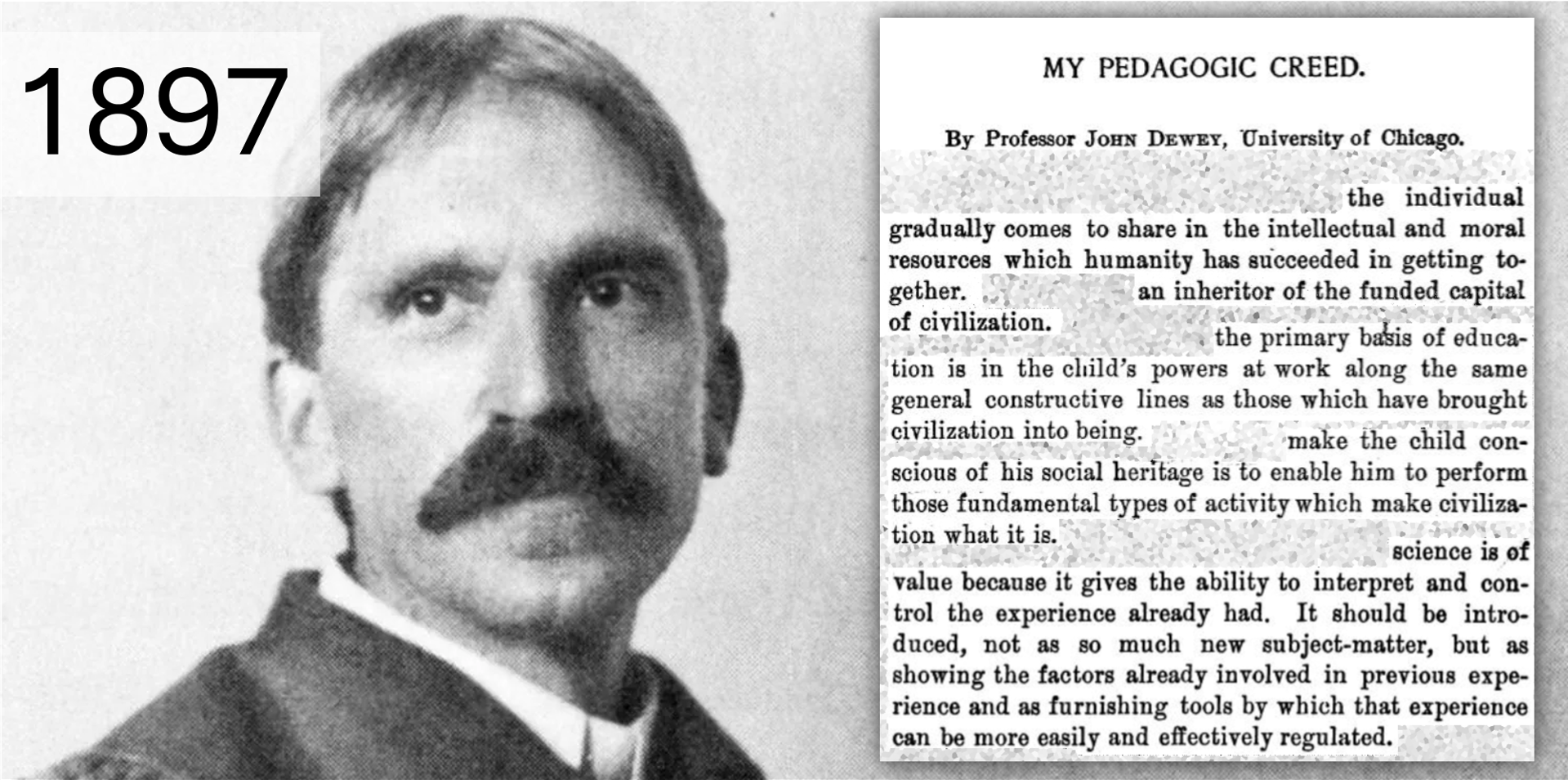
John Dewey, excerpts from “My Pedagogic Creed” (1897).
But Dewey was not an alien from outer space; and modern education has not remained frozen since then. Over these more than one hundred and twenty years, many people, schools, pedagogical movements, universities, and education systems — including in environments caricaturized as rigid but that are in fact demanding, such as corporate and military settings — have tried to move teaching from repetition to understanding, from mechanical training to adequacy to what is experienced, from the canonical answer to situated thinking, from pre-determined action to contextualised decision... and even towards developing individuals’ ability to consciously determine their own personal and cognitive evolution. Yes, I am thinking of proposals such as Paulo Freire’s pedagogy of autonomy, Seymour Papert’s constructionism, or Virginia Kastrup’s inventive cognition, among many others.
Education has changed enormously. Just look at today’s materials, objectives, technologies, modes of participation, disciplines, relationship with work and society; look at the presence of projects, laboratories, online platforms, networks, and digital resources. Today’s school is not the school of one hundred years ago. Nor of seventy years ago. Nor of fifty.
But it is also true that it has not changed as much as it aspired to.
There is a simple reason, although there is nothing simplistic about it: turning a pedagogical ambition into everyday practice is much harder than merely proclaiming that one will adopt it. It branches far beyond what happens directly between the educator and the learner.
There are logistical difficulties: preparatory and follow-up tasks, large classes, packed calendars, many assignments or activities for a teacher to follow, many students needing guidance and advice, in short... many tasks, something terribly difficult to organise, requiring time and attention.
There are systemic difficulties: contradictory objectives that must be answered (”cover the syllabus”, “prepare students for higher-education admission exams”, “make sure they understand at least this, even if we do not reach that”, “avoid complaints”, “do not fall behind with grading”, “have a life”, etc.), inequalities, institutional pressures, opportunistic behaviours, different levels of availability or willingness to collaborate.
There are organisational difficulties: how can teachers and students be managed when learning is less standardised? How can parents or team managers follow open-ended processes, with no exact endpoint, with no clear references for comparison? How can we compare activities that are not alike, or that respond to different purposes? How can fairness be ensured when what is valued is more subtle, complex, and undefined, with more opinion-based criteria, than a predicted answer or a planned state?
And there are governance difficulties: making sense of what is happening, following it, deciding, and intervening when the scale is not just one class or one team we deal with, but a whole school, a whole university, a company, a region, a country.
That is why, throughout this long ambition for change, education has relied on operational shortcuts. Patches, let us call them: responses to the realities and contingencies that made it possible to operate at scale.
The habit of focusing assessment on delivered products is one of those shortcuts.
An essay, a test, a report, a solved exercise, a computer program, a presentation. All this required effort and could function as a reasonable approximation of the thinking we could not observe directly. It was not perfect. It never was. But it was useful enough to organise teaching, assessment, certification, management, and governance.
Another shortcut followed from that one, although it was rarely admitted, and perhaps people even swore that it did not happen: letting form affect substance. Well-built rhetoric, an answer neatly aligned with the rubric, code that ran on the first try, an elegant synthesis, or a well-formatted report, all often seemed acceptable indicators of effort and dedication, and therefore indicators of understanding. In other words: a shoddy piece of work, in any of these dimensions, might be expected to contain more factual or argumentative errors; a piece of work with carefully crafted grandiloquence might be approached with the expectation that it came from someone with stronger work habits and therefore, more probably, with problems at a higher level rather than serious inaccuracies. This helped manage the focus, and therefore the time and effort, of assessment, interpretation, feedback...
AI, fortunately, destroys these shortcuts. First it corrodes them, then it undoes them.
When AI, whether free or very cheap (for example, monthly costs below the price of a night out with friends), can produce fluent text, plausible code, organised syntheses, convincing images, work plans, and well-turned explanations; when AI can tick all the requested points in a prompt or rubric, and reach all the expected technical quality, the appearance of competence is assured. Not because writing well, programming well, or presenting well has become irrelevant. On the contrary: those abilities still matter. It is just that displaying the baseline of competence in a product is now assured. The final product, by itself, has become too fragile as an approximation of the thinking of the person who submits it.
If we ignore this, the outcome is a worsening of superficiality, of course: with AI, someone who knows they are only required to submit an assessment “product” can produce vacuities — things that shine, but represent nothing from anyone. Answers without reflection. The most immediate and generic options. A focus on products as samples of what one thinks, of what one knows, does not distinguish between those who know how to question, revise, choose, and judge, and those who merely accept the first plausible formulation. But the existence of AI also does something useful: it removes the comfort of continuing to treat appearance as if it were relevant to understanding.
There is a phrase I have been using in presentations and other public sessions: reach for understanding, not rhetoric. I think we can draw on several analogies. For example, the arrival of the calculator in mathematics. In the 1970s, some feared that calculators would destroy the learning of mathematics, as a January 6, 1975 article in Time neatly summarised2. The fear had a logic: if the machine does the arithmetic, what happens to the student’s competence in doing it? Does it become useless? Will people become unable to use mathematics? Yes and no. Yes, most people stopped being able to do the kind of calculations people used to do. But society itself changed in its uses and expectations of what mattered, and school changed with it. Instead of regular arithmetic calculation at ever more complex levels, which came to be done mechanically, all children now train mental calculation techniques that were once mostly practised in grocery shops or among traders: estimates, quick approximations to decide or detect problems, immediate calculations for intuitive response... and society opened new paths: bookkeepers became accountants, mere record-keeping for final reporting gave way to scenario simulation, assessment of alternatives, exploration of possibilities, modelling the world with numbers. We can think of what happened to art when photography and cinema appeared, what happened to hunting when agriculture emerged, what happened to farm work with mechanisation.
With the emergence of AI finally accessible to society at large, we are facing a transition at this level. A large part of academic and professional production can now be automated: writing, explaining, summarising, programming, drawing, arguing, revising, translating, planning. Society will therefore change, expectations will change too, and so will what we learn.
If all we want is an undifferentiated but competent product, AI will quickly become that finishing machine for everyone. If we want understanding or reflection, we must create processes in which understanding or reflecting is necessary in order to conduct them. Processes in which assuming, differentiating, judging, imagining, valuing, and maintaining coherence or changing position are part of the path.
In other words, before we exhaust ourselves imagining how to assess old objectives in a new world, we need to discover the new objectives and design instruction for them. For that, we need to re-centre learning on value.
A decision does not occur in a vacuum. For a person to be the one deciding, they need an objective of their own. To have an objective that is their own, they need to appropriate it. Only then can they have criteria to evaluate alternatives. Criteria that are not merely words inherited from someone else, but criteria that arise from valuing something of their own: an idea, a problem, a community, a work, a question, a person (perhaps themselves), a future they long for.
This is the old ambition that AI makes almost inevitable: we are facing an unprecedented pedagogical opportunity. Yes, AI can do much (or all) of the student’s current work: Excel also does the bookkeeper’s sums. Yes, AI can also replace much of what the teacher does today: photography also came to take all the portrait miniatures and locket portraits. But AI can also make it practicable to create or expand a learning ecology where students, teachers, peers, tools, materials, ideas, institutions, and artificial agents interact to reach goals of appropriation, understanding, valuation, and initiative that today we can only dream of. A cognitive ecosystem (as I call it with my colleague Eliane Schlemmer3, whom I thank for awakening me to the relevance of this idea) today not only in some distant future: an educational context that is a habitat, where knowledge emerges from the relations among the entities that inhabit it, not only from or in someone’s isolated head.
To make this concrete, we need to change the design of educational activities.
It is not enough to tell students to use or not use AI. It is also not enough to tell them to be creative or to choose projects that are “theirs” or “that interest you”. Giving freedom without providing structure ends up being negligence and abandonment: yes, some students move forward with intrinsic energy; but others hesitate, or avoid differentiating themselves, through discouragement, fears or hesitations, scheming, or simply a lack of horizons. Personal appropriation needs space, purposes, resources, constraints, interlocutors, moments of intellectual confrontation, and criteria that help make ambition practicable. And perhaps many other things we still need to discover.
For example, in an object-oriented programming course in a software engineering degree, the question is no longer simply whether the code runs with object-oriented syntax and mechanics. The code must run with those aspects, of course. But that is so little — it always was so little. What matters today, as it mattered before, though perhaps we did not dare to aspire beyond utopia, is that the student has an objective for their project, understands themselves, reflects on why they choose one structure rather than another, is able to assume a decision about the structure of the program, identifies future consequences far beyond the immediate, and identifies the constraints they face and the limits they must assume in relation to them.
Another example: in a literature review for a master’s dissertation or doctoral thesis, it matters little if the student is merely accumulating more or less well-written summaries of a collection of texts. That is so little — it always was so little. The ambition today can be the one that existed decades ago, before the massification of these degrees, and that today had almost been pushed back into utopia: that each student, in that review process, truly discovers the terrain before them. Not only the diversity of concepts, contexts, and perspectives, but their contradictions, their alternatives and complementarities, the areas that remain unclear, the possibilities. And in that discovery, they will have to discover themselves: faced with that contradictory, nebulous, vast terrain, what do they really want, what is their intention? What are they willing to dare, what ambition do they take on? The literature review can once again be, as it should always have been, a discovery of intellectual meaning.
These examples need development, not merely one paragraph each. They will come here in future texts of their own. Today I will stay with the idea I have developed as a starting point: AI leads us towards an education in which the delivered product does not represent learning, but rather stages of a process, of a path.
This does not mean that assessment becomes a kind of infinite surveillance of the process, which would be a perversion, an elimination of the construction of value, imprisoned in a myriad indicators to satisfy. It means that we should focus on designing processes that, if followed, promote quality and value. A process in which there is appropriation, purpose, confrontation, reformulation, creation, and transfer across contexts then lets us see more clearly what interests us. Each part of that process helps us glimpse these aspects.
Please do not read this as a celebration of AI, as if we were setting off fireworks and running after the spent sticks. I do not ignore that any transformation carries risks, problems, challenges, and yes, suffering as well as joys. What I assume is that AI forces us to be more demanding about what we call learning. Since the nineteenth century, so-called “modern” education has aspired to form people capable of understanding, judging, participating, creating, and acting. For a long time, that ambition has been limited by the difficulty of making it concrete in large systems, with finite resources and contradictory demands, but I have already spoken of that above and will not return to it here.
Those difficulties remain, in this time of AI, but the balance has shifted. It becomes unsustainable to continue confusing appearance with thought. And, if we know how to work with them, new forms of support, questioning, simulation, revision, creation, and discussion open up.
That is why the most useful question for a teacher today is neither “was it really the student who did this?” nor “what product should students submit?”, but rather:
What old educational ambition does this process finally take seriously?
And, since we are at it (“since we are at it”, I admit, being the riskiest and most expensive phrase in a process):
What process leads the student to value, decide, revise, and assert?
If AI pushes us towards these questions, perhaps it will make us adopt something we have been promising that was just about to arrive, since the nineteenth century.
John Dewey, My Pedagogic Creed, 1897.
TIME, “Calculators in the Classroom”, January 6, 1975.
Note: it is indeed “calculators”; the “calculaters” on that page does not match the printed version.
Schlemmer, E., & Morgado, L. (2024). Inven!RA: a contribution towards platforms aligned with Digital Transformation in Education. RE@D - Revista de Educação a Distância e eLearning.